Sunday, January 19, 2014

Micro


Micro by Michael Crichton with Richard Preston

Although I’ve read just about every piece of fiction by Michael Crichton, I had my doubts going into this one.  First, I haven’t really thought he’d written anything that spectacular in about twenty years.  Then, there was the fact that this book was released posthumously and was actually unfinished at the time of Mr. Crichton’s passing.  It was so “unfinished” that another writer (Richard Preston) had to be brought in to actually add a significant chunk to the finished piece.  Usually, that’s never a good thing, and always has me wondering if the publisher is simply trying to cash in on the author’s reputation.  Of course, I also glanced at the reviews on amazon.com, and more people gave this book a 1 star rating (the lowest possible) than any other rating.  Not a good thing.
But press forward I did.  Before I go into detail, I must first point out that I can see why so many people disliked this book, but I have to confess that I actually enjoyed it!  To understand such an assessment, a plot setting is in order.
There’s a mysterious company in Honolulu that specializes in making “micro robots”.  One of the Vice-Presidents (a young, twenty-something guy) goes to Cambridge in Massachusetts along with some other executives to recruit some young, talented scientists including his kid brother.  As we meet these scientists, the first major problem of this book appears.  Crichton isn’t much (these days) into character development.  There’s a group of about seven kids, and each one has some one-dimensional stereotypical trait, along with a “speciality”.  So we have people here that you can you could describe as: “the leader”,”the whiner”, “the smart athletic female”, “the slutty female”, etc.  The fact that they each have their own speciality (which the author thrusts in our face rather uncouthly) tells us that our story will “need” such an individual at some point as our story progresses.
So these kids go to Hawaii, and the CEO gives them a “tour” of the facility.  Apparently, not only can robots be micro-sized, but (gasp) so can living things!  Do you see where this is going?  Well, it should be pointed out that the older brother vice-president has mysteriously disappeared very recently.  The kid-brother scientist apparently knows something sinister, so when he confronts the CEO, the CEO panics!  It just so happens that all of the students are in the chamber where people/things are shrunk, so the CEO presses the button!  
So, yes, things are a bit silly already, and I found myself laughing when the author probably was wanting me to scream instead.  These tiny organisms are  now about one millimeter in size, and they’re then dumped into the jungle (which for all we know, could only be a few yards away from a parking lot).  The bad guy knows they can’t survive.  The jungle will destroy them!
And this is where are story really begins.  Our miniaturized protagonists are now in a very unfamiliar environment with insects, birds and reptiles that are now huge and mostly very unfriendly.  If this sounds like one of those cheesy 1950 sci-fi movies, you would be correct in your assumption.  For this reason alone, it makes me think that this could never be made into a movie.  It’s been done too many times, and giant ants and mosquitoes on the big screen just don’t phase us like they did one-half a century ago.  You could also argue that this setting is a bit like Crichton’s most famous work, Jurassic Park.  The environment is very similar, and I must confess that I found giant wasps and grasshoppers a lot more frightening than velociraptors and a t-rex.
As corny as this story may sound, I kept turning the pages.  I found myself enraptured in a way I never thought possible about such a silly tale.  This is definitely Michael Crichton, and there’s just enough references to the things of the scientific world to keep your interest without burying you with too much detail.   Like George Lucas of the Star Wars movies, though, Crichton sometimes gets so involved in what he’s good at, that he loses his focus on the basics of a story - such as characters talking to each other.

When I finished reading this book, I felt a bit like I just watched a movie with an 8 year old child that was made for 8 year old children.  I thought it was very silly and very juvenile, but I had to admit that, for some strange reason, I really enjoyed the experience.

Zero Minus Ten


Zero Minus Ten by Raymond Benson
I confess that I was never that big of a fan of the James Bond books.  The creator of James Bond, Ian Fleming, is held in very high regard for all of the James Bond novels that he wrote from 1953 until his death in 1964.  The reason I was never that big of a fan is not necessarily a reflection of the author, nor his style as a writer.  I tend to simply think that “spy novels” were written very differently 60 years ago, and my modern tastes simply don’t absorb this palette of writing very well (I wasn’t even born until after Mr. Fleming passed away.)  Still, though, every James Bond movie up until 1987 was somewhat based on one of Ian Fleming’s novels and/or short stories, and being such a fan of the movies, I simply couldn’t pass up on reading the original stories.
A second author, John Gardner, actually became the official “next father” of the Bond books starting around 1980.  He wrote about 15 or so, churning out about one book per year.  They never really appealed to that many, and those who were still immersed in the Fleming religion frequently screamed “blasphemy” when each book was released.  It was the overall consensus that whereas some of Gardner’s work may have contained some sparks, he simply couldn’t hold a candle to Ian Fleming.  Again, being a fan, I read them all and agreed with most.
So flash forward to 1997 (only about a year after Gardner retired), Raymond Benson is chosen to be the next torch carrier.  Ironic because in 1983,  Mr. Benson actually wrote one of those trade paperback compendium homages called “The James Bond Bedside Companion”, which unlike any other of the glossy retrospectives, his focused not just on the Bond on screen, but the Bond of the literary word as well.  And, yes, Mr. Benson is a huge fan of the Bond books (well, Fleming’s anyway).
So how would Raymond Benson fare, then, as the new author?  I must confess that my expectations were pretty high since Benson could be very critical of anything James Bond related (A bit TOO critical.  As much as I enjoyed his “Companion”, I was a bit turned off by all the negativity he emulated).  
I must say, however, that this was the best James Bond book that I have EVER read.
So much so, that I would recommend it to NON James Bond fans.  The overall story seemed to flow beautifully.  Benson stated that he tried to bring the “old” James Bond back, but I really can’t tell that much of a difference between any of the “Bonds” in any of the books.  He does modernize the M character.  Like the Pierce Brosnan movies that were coming out right about this time, the new M is a lady.  Based on the description of the new boss, it sounds as though Raymond Benson was trying to model her after her cinematic counterpart, Judi Dench.  This is a good thing.  Another good thing is Q is back.  He was gone for the Gardner books, but he’s thankfully been resurrected under his true moniker, Major Boothroyd.
The setting for this tale is Hong Kong in 1998.  I normally wouldn’t mention this, but Benson carefully constructs some major, real-life history in this book.  Without going into detail, 1998 was the year that Britain had to “hand back” Hong Kong to communist China after over 100 years of English rule.  People were a bit panicky back then, as no one really new how China would handle a democracy that would now firmly be under her rule.  This adds a lot of suspense to the plot, as this story is essentially leading up to this particular event.
So all the key elements of a Bond novel are here, and Benson weaves through all of the intricacies quite masterfully.   You never get lost as to who is who, nor what anyone’s motivations are.  It’s simply a great story with many interesting plot twists, character twists, and exotic locations.
My only criticism is that sometimes Benson tries a bit too hard to be like his idol Ian Fleming.  Fleming could sometimes get sucked into giving us a bit too much detail around an event.  Remember the scene in the movie Goldfinger when Bond realizes he’s being cheated on the golf course?  Well, thankfully the movie only spends a few minutes detailing the event.  In the book, however, Fleming details each and every hole of the entire 18 hole match.  You think watching golf is boring?  Try reading about it.  Fleming would repeat this instance of the bad guy trying to cheat Bond at some game (Bridge, Poker, Backgammon), only to have Bond outwit him.  All this to say that Benson has the same setup here between Bond and the villain as they play a game of Mahjongg.  Now, I’ve never played the game, so when Benson spends an entire chapter detailing the game, the progress of the game, Bond being cheated at the game, and then Bond’s strategy to cheat the cheater of the game…… Well, it goes on a bit too long.  A minor complaint, however. 

I’m eagerly looking forward to reading the other five installments by Raymond Benson.  I was very pleased and very surprised at how much I enjoyed this book.

Eisenhower: Soldier and President


Eisenhower: Soldier and President by Stephen Ambrose
I fell in love with Stephen Ambrose’s style of writing after reading his 3 volume retrospective of Richard Nixon.  He’s very clear, concise and easy to understand.  He seems never to spend too much time on laborious details about any one event in his subject’s history except where obviously needed (case in point – volume 3 of the Nixon series spent a lot of pages on the Watergate crisis.)
Because of this, I was a bit put off by the fact that this biography is actually an amalgamation of two books that the author devoted to Dwight Eisenhower – the first one focused on the soldier, the second one, the President.  I’m not a big fan of anything abridged when it comes to literary works, but I confess that I couldn’t pass up on the bargain price offered up by Kindle!  So, suffice to say, I think I would have liked to have read more, but whether or not the information I would have liked the author to expand on is discussed in the two “uncut” versions remains unknown to me.
That’s not to say that this is not a good read.  Everything that I expected from an author such as Ambrose is present.  We don’t get too much detail on Eisenhower’s early life – other than he was a typical Midwestern boy around the turn of the twentieth century who had four brothers, got into a lot of fights, and played a lot of football.  Yes, even then you could see that this young boy had the potential to be a general and/or a president.
Although he enters the army via West Point, he never engages in any military conflict up until World War II.  His promotion to General is based on tenure, and not necessarily accomplishments (the only real action he could have seen was in World War I, yet he “just missed” being in the thick of things).  One thing that all see in this brilliant young man is his ability to succeed at battle “case studies” that is apparently prevalent in one’s military training.  He has the smarts to know just how to win the big battles.  As World War II progresses, he’s in some very high level conflicts.  He makes mistakes, but is such a strong leader that eventually everyone “back home” likes Ike.  Loves him actually.  Strangely, the politics of war time can be just as exasperating as anywhere else, and by the time Ike is the Commander of Allied Forces in Europe, he has to deal with a lot of bickering - especially with Bernard Montgomery and George Patton (the two men hated each other, and Ike really doesn’t care for them either).  Still, he succeeds as a strong leader should, and we get a very detailed glimpse into the preparation of Operation Overlord (D-Day).  Although history tells us that this turning point was a major success, there was a lot of gambling, second guessing, and uncertainty up until the morning of the invasion.  This event alone warrants its own narrative (which Ambrose, amongst many others, has written).
Ike is such a national hero that everyone wants him to run as President upon conclusion of the war.  Even current President Harry Truman wants him to run in 1948 (Ike declines, Truman is re-elected).  Finally the masses are placated in the 1952 election, and Ike has two successful terms.  That’s not to say flawless – he makes several mistakes, but overall history holds his presidency in higher than average regard.  The best thing about Eisenhower’s presidency is that the man never had to pander to anyone.  Being a successful five-star general essentially means you can win election to the highest office of the free world without having to kiss anyone’s backside.  This was very refreshing.  The man never really cared much about what others thought of him.
Such attitudes did have some downsides however.  One example was his Vice President, Richard Nixon.  Although the relationship between the two was never perfect, Ike did respect Nixon.  He wanted Nixon to step down as Vice President in 1956 and accept a Cabinet position instead so Nixon could be “better prepared” to be President one day.  What Ike never realized is that such a move would have been viewed as a horrible demotion and probably would have killed Nixon politically.
Unlike the stereotypical war monger that becomes Commander in Chief, Eisenhower is very cautious when it comes to the military and military spending while he is President.  Quite frequently, Eisenhower is constantly telling the country that the military is too large, spending too much money, and has too many bombs.  He is persistent in balancing the nation’s budget, and if he has to massively cut military spending, it’s a no brainer to him.  It’s not that Ike has become “anti-military”, it’s just that as a successful military leader, he’s smart enough to know it’s not how much money you spend on defense, but how you spend money on defense.  He looks at the military in the nuclear age as just being wasteful.
We also read about wife Mamie, son John, and his wartime secretary Kay (despite consistent allegations over the years, an affair was never proven between the two, but it’s very obvious that the two were somewhat in love with one another being so far from home during the war.)  Ike’s post presidency years are talked about a bit too briefly.  I was hoping for more reflections as to his thoughts on the country during the 1960s.  It’s talked about, but not as much detail as I would have liked.  Why, for example, was Eisenhower so against involvement in Vietnam back in 1954, yet seems to be one of the biggest hawks of the 1960s during the Lyndon Johnson administration?  This was very odd indeed to read, and I had to wonder if Ike was getting a bit senile.  I wish there could have been more explanation.
Although this book is favorable towards Eisenhower, I was very pleased that the author showed the man’s warts as well.  He was not perfect.  Especially heartbreaking was his response (or lack of) to the Civil Rights movement.  He literally just wished the whole problem would “go away”, and worried too much about alienating his southern friends than he did pursuing equality.  To be fair, this seemed to be the attitude of most leaders in the Oval Office (even, to some extent  Kennedy and Johnson), but you can’t help wonder how much better things could have been, and how the Civil Rights movement could have taken bigger leaps in a quicker time frame had Ike actually cared.

Reading about the goods and the bads is what I always like in a biography, and I’m very glad that the author didn’t elect to gloss over nor ignore the man’s shortcomings.  I can now honestly say, that overall, I like Ike.

Split Second


Split Second by David Baldacci
For fans of David Baldacci’s “King and Maxwell” series, this is the first one where we meet the couple.  We start our story eight years in the past.  Sean King is a secret service agent guarding a presidential candidate.  During a speech where king is guarding his boss, the unthinkable happens - an assassin kills the presidential hopeful with one bullet.  Although King  returns the favor and knocks the assassin out with a bullet of his own, he’s basically too late.  Sadly, if you’re a secret service agent and the guy you’re protecting goes down, your career is basically over.
Flash forward to the present day.  There’s another scenario with another secret service agent (that would be Michelle Maxwell) guarding another presidential hopeful.  Like King, she makes an innocent “slip” and her “assignment” is kidnapped.  So she’s finished as well.  Fortunately, King has picked up as life and is doing pretty well, yet there are a series of mysterious murders that are popping up with his acquaintances being the targets.  Since the latest presidential hopeful is a kidnapping, it provides an opportunity for these two washed out secret service agents to meet each other and join forces to bring some sort of redemption for themselves and their careers.
Although these two characters are described as flawless specimens of beauty, their relationship remains purely platonic.  They work very well as a team, and with the help of a huge supporting cast of characters, the hunt is on.  I should say “an extremely” huge supporting cast of characters.  I found this to be a bit of a drawback, as my brain was constantly having to shuffle all of these individuals in my head - trying to remember who is who.  This is one of those books where we “meet” the bad guys as well, but Baldacci keeps their identities as a mystery as well as their motivations, so this keeps up the curiosity factor.
Everything pretty much goes as you would expect it to in a story such as this.  We see our heroes’ make slow progress as they interview people, discover clues, investigate locations etc.  When the bad guys are finally revealed during the climax, I found it a bit weak and out of character.  True, we’ve only met these shadowy figures sparingly, but when we discover the true motivation and purposes of the so-called showdown, it comes across as a bit too fantastic and somewhat silly.

I enjoyed this book overall.  It’s fun to match wits with the two heroes, and anytime we meet new characters within the pages, you simply know that although they may seem inconsequential to the plot of the story, the author spends so much time with them, that you simply know that we haven’t seen the end of them.  There were a few times where coincidences and fate seemed placed a bit conveniently within the story, but it was mostly a fun ride.  

Monday, December 30, 2013

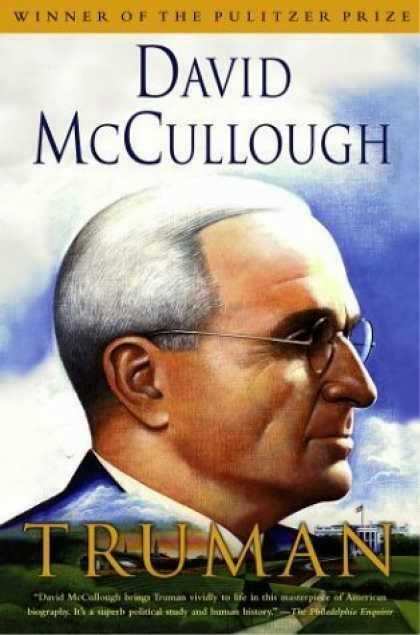
Truman


Truman by David McCullough
Before I read Truman, my favorite presidential biography was Edmund Morris’ The Rise of Theodore Roosevelt.  I found it ironic that this one eclipsed Morris’ epic as my favorite since Theodore Roosevelt and Harry S. Truman were such different individuals.  To be blunt, Roosevelt was an incredibly exciting character - especially prior to becoming president.  Truman, to be equally blunt, was not.  He was actually kind of a boring human being.  So why did I enjoy this 1,100 page epic so thoroughly?  A large part was due to McCullough’s writing.  This was such an immense joy to read.  The author knows exactly just how much detail to spend on the events of this man’s life, that you get the impression that any retrospective he would pen about any individual would be incredibly interesting.
That’s not to say Truman’s story should be ignored.  This was an incredible figure of the United States history, and he quietly went out and accomplished many milestones for the United States when the country needed a president to do just such.  It’s easy to forget that this man was a crucial part of the Potsdam conference at the end of the European conflict, the decision to drop the secret atomic bomb to end World War II, the Truman Doctrine, the Marshall Plan, the formation of Israel, the creation of NATO, and the (most would argue) correct decision to enter the Korean “Police Action” - although he would end up firing the beloved Douglas MacArthur right in the middle of the conflict.
What I enjoyed most about this book is that Harry Truman never really wanted to be president.  That seems so bizarre in our modern world of power and demagoguery that someone could rise to the highest office in the free world with such a lack of ambition.  Truman doesn’t even try to enter national politics until he’s 50 years old!  Helped with local Kansas City “boss” Tom Pendergast (meaning it was essentially Pendergast and company that decided who would get elected), he’s propels from being a local county judge to the United States senate.
His career as a senator was mostly inconsequential until World War II began.  When the war started, he was asked to lead up the Committee of Military Affairs, which essentially eliminated profiteering and wasteful spending during a time when the country was asked to kick up its defense spending up several notches.  He began to accumulate a reputation of being an incredibly likable fellow, yet tough and uncompromising.  Without going into too much detail, he’s asked to replace Henry Wallace as Franklin Roosevelt’s Vice President during the election of 1944.  Even though FDR had served three terms already, this election is going to be a tough one, and the Democrats need someone on the ticket with FDR who’s not necessarily substantial, yet mild and meek enough not to rock the boat.  I found this to be a bit puzzling, since Roosevelt was already very sick, and although the public didn’t know it (no CNN back then, remember), he didn’t seem to have much life left in him.  Sure enough, Roosevelt passes away after about 100 days into his last term.
So now, the most unlikely person is thrust into the role of Chief Executive.  It’s incredibly humorous to read Harry’s thoughts about this job.  Although he doesn’t want it, he’s more than capable of doing what needs to be done, and an awful lot needs to be done.  Usually, when I read presidential biographies, the pages devoted to the time spent in the high office are the least interesting.  There’s only so much I can read about labor strikes, inflation, controversial bills, and egos on Capitol Hill without becoming a bit disinterested.  This is one of the main strengths of this book - that the author knows just how much information to fill the pages to keep things interesting without making a biography sound like a dissertation.
A highlight of the book for me was the “Whistle Stop” campaign for the Presidential election of 1948.  Although Truman really didn’t want the office, he did well enough to feel he was up to the job, yet everyone in Western Civilization seemed to think he had no choice against the Republican challenger, New York Governor Thomas Dewey.  The campaign and race was the perfect illustration for the “Tortoise and the Hare” tale, which ultimately led to a Truman victory, despite the famous Chicago Tribune headline boner.  Truman simply refused to give up, continuing to meet people in town after town, whereas Dewey was essentially a fat cat who didn’t feel the need to campaign aggressively and essentially handed a win over to the sitting president.
When the Korean War begins (known as a “Police Action” or “The Conflict”), the public is very fickle.  At first, everyone rallies around their Commander in Chief, but then when the reality of war hits (i.e. soldiers die), people want to get out of Korea, and get out fast.  Leading the military over in Southeast Asia is General Douglas MacArthur.  MacArthur is everything that Truman is not, (big ego, wanting a lot of headlines, thinks he’s infallible, etc.) and it’s no surprise that the war between these two individuals makes more headlines than the actual war itself.  Truman has no choice but to fire the General of the Army.  This turns out to initially be political suicide, yet after hearings in the Senate, it’s essentially proven that Harry was, once again, right all along.
Truman has no desire to run again in 1952, and General Dwight Eisenhower is elected as the next Commander in Chief.  It’s a bit ironic since many wanted Ike to run for President as far back as the conclusion of World War II (including Truman), yet no one knew much about the man – even if he was a Republican or a Democrat.  As 1952 draws closer, Truman meets with Eisenhower – trying to convince him that he should be the next Democratic President of the United States.  Initially, Ike is disinterested, yet somehow, sometime later, he changes his mind.  Only to Truman’s chagrin, he runs as a Republican.  Despite this, Truman still feels Eisenhower is the best for the job, yet the relationship between these two men is strangely very strained during the rest of their lives.  Truman always wonders (as we do) exactly why.  Regardless, Truman is happy to leave Washington, and the book gives us minor details about Harry’s later years up until his death in 1972.
A great asset that the author had when compiling this work was a vast amount of personal correspondence from Truman that survived.  There are masses of letters (many intentionally never sent) that sums up the man’s personality very well.  The man was very devoted to his mother, his sister, his wife, and his only daughter.  We see many personal diversions from the everyday office with his family affairs, and it’s all very refreshing.  I found myself chuckling out loud during many of the retellings of Truman’s writing and his thoughts.  One I remember was in response to the famed “Give ‘em Hell Harry!” moniker.  Truman claimed: “I never gave anyone hell, I simply told them the truth….which everyone THOUGHT was hell.”
I couldn’t help but wonder how wonderful it would be to have a man like Truman in office again.  Despite your politics, it should would be nice to have a president that really didn’t want the job, but gave it the best he could offer and, for the most part, never really gave a rip about what the polls said about him.  This book was a bit lengthy at over 1,100 pages.  There were times near the end that I thought it could have been summarized a bit more.  There seemed to be a bit too much detail on the renovations of The White House (it was falling in disrepair during Truman’s administration, and he had to move across the street in the Blair house), but this could have been that, like the job itself, things simply aren’t as interesting after one has been the leader of the free world.

I wish that every president in our nation’s history could have such a thought out, easy to read detail of their entire life.  Well worth the accolades.

The Bone Collector


The Bone Collector – by Jeffery Deaver
Imagine that you’re reading a story where two characters are in a room with a large, massive haystack.  A third character puts a gun to their heads and tells them that they have one minute to find a small needle in this haystack.  Somehow, miraculously, without any explanation, the two characters manage to find the needle – with about one second to spare before their life gets ended.  Then, the same three people walk into another room, with another haystack, and the two people are given the same ultimatum.  Again, they somehow find the needle – with no explanation as to how, with only one second to go before the trigger is pulled.  My guess is that after this scenario is repeated four or five times, you would tend to become very frustrated with the story and these chain of events, and tend to write off this tale as being “unbelievable”.
Sadly, I felt these exact same emotions while reading The Bone Collector.  There’s a homicidal maniac on the loose in New York City.  He kidnaps random victims with the intention of slowly killing them, yet leaves just enough evidence (by “just enough” I mean “barely any”) to where the cops show up just in time to save the poor victim’s life.  Usually with seconds to spare.  And then, the cycle begins anew.
This is the first “Lincoln Rhyme” novel that author Jeffery Deaver penned.  Lincoln is a brilliant criminalist who’s able to miraculously string together the most minute details based on almost no evidence, and immediately know where, when, why, and how the serial killer will strike next.  Pretty impressive when we’re talking about a story that takes place in Manhattan with literally billions of nooks and crannies for psychopaths to hide.  Lincoln, also, is a quadriplegic.  He’s not a very friendly guy either.  Because of his condition (he was injured a couple of years ago in the line of duty), he’s confined to his home lab along with an assistant and some other law enforcement type characters to do his thinking and planning.  The local police actually go to him as soon as this lunatic is discovered since Lincoln is the only one that can help solve the crime quickly.  Did I say “quickly”?  It’s amazing just how much happens within a short, 48 hour time frame.  There’s enough crimes, dialogue and clues that would last a normal detective story about six months, but for some reason, the author seems compelled to make a lot (too much, really) happen in a very short time frame.
So innocent people get kidnapped, the “bone collector” (what our psycho is known as) drags them to some bizarre, hidden location, and tries to kill them (or have them killed) in some slow, painful way.  Because this is how he can “preserve” his victim’s bones.  Yep.  He’s a weird one.  Of all of Lincoln’s helpers, the young, ravishing beauty beat cop named Amelia Sachs stands out the most.  And I do mean “stands out”.  She’s the perennial beauty that shows up in most police stories.  You know, the one who looks like she’d be more at home modeling for Vogue as opposed to casing crime scenes.  Well, Lincoln and Amelia end up bonding pretty well.  Their attraction goes much further than your normal professional relationship, yet never too far.  After all, the man can’t move anything on his body other than his neck or one of his pinkies.
So this dynamic duo work very fast, with a lot of obstacles, and somehow manage to save the day.  Author Jeffery Deaver has actually written several novels featuring Rhymes and Sachs, yet this was the first one where we meet these two.  I must say that I’ve read some of the others, and actually enjoyed the others better than this one, but it was nice to see how these two met, and how their relationship began.
I was glad that I already was familiar with these two characters, because too much of the story didn’t sit well with me.  Apart from the plot being so unbelievable, I confess that I’m not a big fan of reading details about innocent people being kidnapped and tortured – regardless of whether the victim is male, female, young, or old (I believe there was at least one of each in this story).  Then, the technical, criminalist jargon was a bit much for me as well. There are a lot of big, forensic words in this tale, so at least we know the author did his homework.  It’s also helpful that he includes a glossary at the back of the book.

Still, it was nice to see how it all began with these two, so overall, I have to say that I enjoyed the story – just not as much as some of the others.  I also need to give the author credit for always knowing how to end a book.  He always pulls a few surprises by the time we get to the last few pages.  So much so, that I was waiting for a nice plot twist near the end, trying to figure out just how I would be duped again by the author.  Not surprisingly, I failed, and Mr. Deaver managed to surprise me once again.  His endings are always so well done, that they always make me add a few “points” to one of his book reviews.  Overall, this book was pretty good.  Not great, not awesome, but pretty good. 

Sunday, December 8, 2013

Playing for Pizza


Playing for Pizza by John Grisham
Rick Dockery has to be the biggest goat ever in NFL football.  A third string quarterback who is bounced from team to team ends up on the Cleveland Browns, who are on their way to their first ever Superbowl.  In the Championship game, wouldn’t you know, the first two quarterbacks get hurt, so Rick comes in and manages to throw three interceptions in the last eleven minutes of the game sending his team to a brutal defeat.  He gets hurt as well - he’s knocked unconscious and ends up in the hospital.  The furious fans don’t care though.  As a matter of fact, about 100 angry diehards protest outside the hospital calling for the guys death.  
And you thought Philadelphia had tough fans.
Well, not surprisingly, Rick’s agent tells him that he’s obviously finished.  The only gig he can secure for Rick is in the country of Italy.  Do they actually play football in Italy?  Well, yes and no.  They have something resembling a league, but the local players don’t get paid (they have normal jobs), fans don’t pay to watch the games (on a good day, a few hundred will show up), the field is only 90 yards long (they convert old rugby fields), and there are no cheerleaders (although Rick’s agent lies to him and tells them that there are).  So Rick doesn’t really want to go, but he doesn’t have many choices and he needs to get away from Cleveland as quick as he can.  The “cheerleader” promise is probably what does it.  Rick has a thing for cheerleaders.  Sure, his agent lies, but agents are agents for a reason.
When Rick arrives in Italy, the book details many aspects of the Italian culture that most readers aren’t familiar.  We read an awful lot about the crowded streets, the popularity of opera, the little cars, the wine, and the food.  Oh the food.  Italians obviously love their food - in quantity and quality.  I’d recommend that you skip this book if you’re on a diet.  On the other hand, if you really love food, it wouldn’t surprise me if you plan a trip to Italy on your next vacation.
So washed up Rick is challenged to lead a rag tag group of Italians to their first “Super Bowl”.  It won’t be easy.  Each team is only allowed only three Americans.  At least the Americans get paid.  The vast majority of Americans are over there because, sadly, the life of the majority of football players who are great, but never great enough to succeed in the NFL, seem to make the trip as the options are indeed scant (as I write this, ironically, Tim Tebow is in the news for considering going to Italy to play).
If anything, this books serves as a bit of a redemption story for washed out Rick.  Sure, he’s majorly bummed when he finds out he was lied to about the cheerleader thing, but….well…. Italy is known for beautiful women.  He makes some mistakes on his journey, but manages to hold his head high and bring a bit of excitement to the lives of these ordinary locals.
Like all Grisham books, the author never fails to keep your attention.  I was surprised what a good story this was - both on and off the field.  I seem to recall Grisham giving us just enough play by play for each of the games to hold your attention - even if you’re not really a fan.  He does a really good job keeping things fresh, which isn’t that easy for a “sports” story.  Especially a football one  (I seem to recall his other football tale “Bleachers” to a be a bit too predictable.  It was nice, but it was a story we’ve all read before.)

This is a very quick read.  Those who enjoy reading can probably consume the entire story in one or two sittings.  This would make a very cute and funny movies as well  (unlike Skipping Christmas - the WORST John Grisham ever!)  I would also guess that you don’t even have to be much of a football fan to enjoy the story, either.