Monday, February 17, 2014

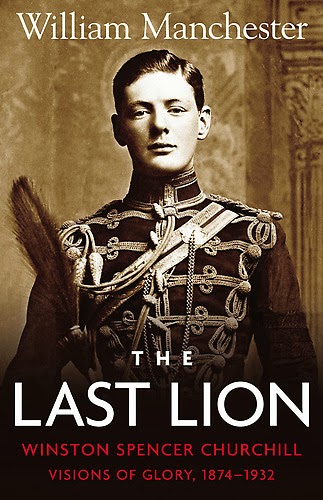
The Last Lion Volume 1: Winston Churchill: Visions of Glory 1874-1932


The Last Lion Volume 1: Winston Churchill: Visions of Glory 1874-1932 by William Manchester
I had known that William Manchester’s biography of Winston Churchill is widely regarded as the best of the lot.  What I did not know is that this retrospective was three volumes – each at about 1,000 pages.  That’s about 3,000 pages total.  Yikes.  So I approached this first volume with tiptoes and trepidation.  Could I actually make it through 3,000 pages?  Is it even possible to write so much about one person?  Would it keep my interest?
After finishing the first volume, for the most part, the progress report is highly favorable.  This is a very long, detailed account of one of the most celebrated figures of the twentieth century.  Now, when one says “long”, that usually means “too” long, but that really isn’t the case here.  Manchester is simply meticulous, and he doesn’t leave anything out.  It should also be pointed out that this first book covers 58 years of the man’s life, so the 1,000 pages or so can’t really be criticized too heavily for only reasons of excess.
What I found a bit peculiar is that the introduction to this book actually gives a brief (well, semi-brief – I’m guessing about 50 pages.  Since I read an e-book without page numbers, I’m not entirely sure) overview of the man’s entire life.  Why give a synopsis of the entire story right before you begin to actually tell the tale?  Perhaps the justification might be that the masses who are familiar with the man only know that he was the Prime Minister of England during World War II, and the author wanted to let us know that there was so much more to the story.  I didn’t find this cumbersome, yet it did seem a bit unnecessary.
Right after this introduction, he then goes into an….um…another introduction?  (Maybe it was a “forward” or something.  I can’t remember).  In this portion, the author takes another 50 pages or so to describe 19th century England for the novice reader.  This, in fact, I found very helpful.  Maybe since I’m a citizen of the U.S. and know precious little about England’s varied history.  It was definitely an asset when describing not only all of the arms of the British Empire, but how the English Aristocracy actually functioned, and how it was drastically different that the vast majority of the starving peasants that lived in the fetid streets of London.   Churchill was born into that aristocracy, so it helps the reader digest a lot of the “normal” comings and goings of those relevant to the biography.
So we finally then get to Winston’s early years.  This book describes his parents to basically be a couple of pompous jerks who see their children as a major annoyance.  Winston and brother Jack are quickly sent off to public (similar to what Americans would call “private”) school, and their parents are more concerned with throwing lavish parties then wanting to be bothered with their children.  Winston feels the rejection, yet it never seems to overwhelm him too much.  Again, the forward to the book leads us to believe that this was perhaps a bit more common in the echelons of England’s high society.  Particularly annoying is Winston’s American mother.  I guess I could describe her as “promiscuous” (that sounds nicer than “slut”).  I couldn’t keep up with all of the men she was sleeping with – both while married and after Winston’s father died prematurely.
After school, Winston spends time in the armed forces.  He goes to a lot of places, and is in a lot of battles.  This never bothers him.  He, and all of the youth of England, actually crave the battlefield and have absolutely no fear of dying in combat.  It’s suggested that Churchill is using the battlegrounds as a step to politics, which is where most of the book focuses.
When Churchill does go into politics, this is where I frequently got lost.  It wasn’t that the writing was poor, but I simply don’t know that much about politics in England.  I really couldn’t tell you what a Prime Minister really does, what the relationship is between Parliament and the “Royals”, the difference between the labours and the liberals, nor the difference between the tories and the conservatives.  Let’s just say that I was very relieved that reading an E-book allows you to quickly look up stuff on Wikipedia.  I’ve never had to use a reference site as much as I did when I read this book.
So all of the details are here up until 1932.  A lot of them are good for his career, but a lot more seem bad.  Lots of mistakes are made in the man’s life, and he learned a lot of lessons the hard way.  Sometimes I felt the details were a bit too drawn out (the failed Dardanelles experiment in the First World War comes to mind), yet overall the story flowed very smoothly with all events packed in rather tightly.  
The main thing you have to admire about Churchill was that he was definitely his “own” man.  He never seemed to want to say what the masses wanted to hear, nor say what he was “supposed” to say.  He spoke his mind.  Rather brave for any politician.  So although this caused many problems in his political life, it’s easy to now see, in retrospect, how it was just this attitude that helped England win the Second World War.

I’m looking forward to the next volume – but my brain needs a bit of a break before I plow back into the man’s life.

Ender's Game


Ender’s Game by Orson Scott Card
I confess that I’m not that much of a Science-Fiction fan.  To me, it seems like every Science-Fiction book 1) Takes place In the distant future (unless it’s in a galaxy far, far away) 2) Involves interplanetary travel, and 3) Revolves around a society where the masses aren’t too happy for whatever strange reason. 
Ender’s Game fits into all three of these categories.  It takes place on Earth sometime in the future, and the biggest worry is a repeat of an alien invasion by a group of extra-terrestrials known as The Buggers.  Therefore, it’s society’s main goal to do everything to repel such an invasion if a repeat is to occur.  We must not let The Buggers destroy the planet (and other surrounding planets where humans live – I think).
Specifically, the Earth must have some smart soldiers to command our galactic fleet.  Very smart.  How smart?  Well, it seems that selective breeding is even done between sets of genius parents.  One group of parents breed a couple of kids who are very close to being “able”, but their two children aren’t quite the caliber needed.   They come close, however, so  this set of parents are allowed to breed a third child – practically unheard of in this future world, and little Ender Wiggin is born.
By the time Ender is only six years old, he’s recruited into Space School. He’s been “observed” since his birth, and this kid does, in fact, have what it takes.  He’s not forced to go to this school, but he’s highly encouraged.  The human race, after all, needs someone like Ender.  So he has to leave his parents and older siblings.  This really isn’t that big of a deal – the only family member he really cares about is big sister Valentine.  His older brother resents him so much that he’s constantly beaten and bullied, so there’s no love lost there.  So Ender is now off to learn how to beat The Buggers in Space School.
Space School isn’t really a happy place either.  There’s many other kids there as well.  Ender is young for his advanced abilities, so he’s placed with older kids.  Older kids mostly resent him just as his brother did, so Ender gets picked on a lot.  The Powers That Be realize this, but they’re o.k. with it.  After all, they’re teaching this boy to be a fighter.  Plus, he’s homesick.  A little, anyway.  A lot of time at school is not necessarily spent on study, but rather on “battle” games.  There are a lot of these games within these pages.  I envisioned these things looking like the lazer tag games that kids today play at the pizza parlor – only without gravity.  They’re in space, remember.  So, after each and every game, Ender “learns” something to help him on his way to becoming a leader in the field of space battle.
After he’s at school for about five years, the head honchos (who observe everything these kids do all the time, it seems), decide that Ender is now ready for “Command” School even though, like when he first arrived at Space School, he’s extremely young.  So Ender arrives at some other galactic post, and many of the same types of lessons are taught.
This book was a very quick read.  By the time I only had about fifty or so pages left, I began to worry that this book was going to leave the reader hanging  (I think there are 4 other “Ender” books, and didn’t want to have to read 4 more to figure out the conclusion), yet the author actually brings the story to a very satisfactory ending.  Anytime you’re transported to a Sci-Fi world, you’re never going to know everything there is to know about your new surroundings, but I was happy with Ender’s “ending”.
I also found it kind of neat (and eerie) that although this book was written in 1985, this futuristic world featured devices similar to what people use today.  Things such as portable work stations that people used called “Desks”, that seemed to function exactly the way that laptop computers operate.  Society uses these “desks” to globally communicate with others through something called “Nets”.  Whoa. There’s another scary coincidence.   Maybe author Orson Scott Card knew things 30 years ago that no one else did?
I was also very pleased that this book was only about 300 pages or so.  I can see where another author could take such a story and drag it into the same tale, yet take twice as many pages which would probably have put me to sleep.  As I write this, a long awaited film adaptation has just been released (starring Harrison Ford and Ben Kingsley).  Of course, most seem to really like the movie except the purists.  

I wouldn’t mind reading the other four books some day.

Where is Heaven?


Where is Heaven?  By Phil Bowie
I debated whether or not to even include this one in my blog.  Not only was this book awful, but it was awfully written as well.  A note to Kindle users everywhere: Beware of “free” books, or books offered very cheap.  They’re probably heavily discounted for a reason.
I thought this book would be a nice read.  The tag of this book describes it as written by a man who is a skeptic about faith, yet has a Near Death Experience and now believes in God.  I’ve always been interested in so-called Near Death Experiences (especially as I get older, and death isn’t quite as far away as it once was!)  Are these experiences “real”?  Or are they result of a dying brain not getting enough oxygen?
Let’s just say that this book has absolutely nothing to do with any Near Death Experience.  The author basically fills up the pages with his own personal tirade against religion.  He talks about a lot of “good things” that he sees in churches and in religion, yet also the “bad things”.  The bad far outweigh the good in his mind, so he goes on and on and on.  This book is basically just a rant.
The frustrating thing is that he refuses to expound on any of his observations.  Example: He easily dismisses Jesus’ “water into wine” miracle because it’s (get this) “only in one of the four gospels”.  Yes.  He actually wrote that.  He doesn’t spend any time talking about the reason for this miracle, and what the true meaning behind it was.  He seems to think that Jesus was simply putting on a “magic show” and since people enjoy drinking wine more than they do water – he’ll just pull a rabbit out of his hat and improve the beverage selection.  Now, to be fair, there are a lot of Christians that don’t understand the point of this miracle either (I would recommend a Google search or two), but this is simply lazy writing.  In fact, he purposely avoids a bibliography because he states that anyone can “look up this information on the internet or on Wikipedia”.  
O-kaaayyy.
So what, then, is the answer to the question in the title of his book?  You know, the one about where Heaven is?   According to this author (and he spends very little time discussing this) is that there is no real heaven.  Not a place, anyway.  I mean, if there was, how come we can’t see it with the Hubble telescope?  Heaven is merely in our hearts and in the memories we leave others.  Same with Hell.
Now, even though I don’t agree with this author’s beliefs, that’s not why I hated the book so much.  I think the main reason was, again, the description of the book, and the fact that it was highly misleading.  Although I got it for free, I noticed that the very next day the price of this book was now $4.99.

Please don’t spend $4.99 on this book.  If you do, I can promise you that you will then be in “Hell” - according to how this author describes it.

The Bourne Supremacy


The Bourne Supremacy by Robert Ludlum
Remember when you were a kid in school and you would lean back on the back two legs of your chair, and you would ALMOST fall down, but you’d CATCH yourself at the last second?  Remember how you felt during that second?  That’s about how Jason Bourne must feel for the entire 650 pages of this book.  Talk about non-stop action.  How this guy can survive all of this constant turmoil is beyond me.
When we met Bourne in the first novel, The Bourne Identity, we pieced a bit of his history together.  Apparently, he was a good-guy killer used by the U.S. Government.  The problem was, he didn’t know who he was at the beginning of that story since he was suffering from  amnesia.  As that story unraveled, we found out that he was really a man named David Webb, but he took on this alter identity after suffering the horrors of Vietnam and witnessing his young family become slaughtered.  So the government uses him for their dirty deeds in the world of foreign espionage.  He’s real good at that sort of thing.
As this story opens, the government needs him again, but he’s “retired” living with his wife (the one he kidnapped in the first book).  They need him because there’s a “counterfeit” Jason Bourne knocking off people in Asia, and the government pieces together that the Chinese government is trying to sabotage the forthcoming handover of Hong Kong from the British Government (this event actually took place in 1997 - about a decade after this book was written).  The only way the government can get the real Bourne to act out his mission, is by kidnapping his wife.  So the rules are simple - find the counterfeit Bourne, do away with him, and you can have your wife back.
So the pissed off real Bourne (really David Webb, remember) is back in action.  I should probably capitalize the word “action”.  Holy cats.  Every time Bourne turns around there’s an explosion, a kidnapping, someone being tortured, someone being raped, et cetera, et cetera.  Such scenes usually work better in a film as opposed to a book, but Robert Ludlum knows how to make scenes like this work on the printed pages.  That’s not to say this book is necessarily easy to follow.  Although the main story is simple enough to keep you from getting lost, I confess that I got very confused many times during the smaller scenes within the story.  Maybe there were too many characters with too many identities, or maybe it’s just Ludlum is very “thick” with his writing.  I kept asking myself things such as: “How did he know there would be an assassination attempt?”, “Why did he garrote  that guy in the alley?”, and “Why, exactly did Mao’s tomb blow up?”.  After awhile, I simply gave up and just accepted that Bourne knew what he was doing, and I shouldn’t try to keep up with his thoughts and actions.
Tons of action isn’t necessarily a great thing.  Although it was overall enjoyable, there were times when I wish that Bourne would stop and take, you know, a nap or something.  Unlike James Bond, this guy has no time to enjoy a drink, a game at the casino, or the company of a gorgeous woman.  I felt exhausted at times just reading about how Bourne felt after going (what seemed like) days without any sleep.

As much as I enjoyed the book, I thought it was a bit too long.  As I mentioned, the book is about 650 pages in length, yet these are also dense pages - with small print etc.  After I finished about 500 pages, I was more concerned with how soon I could finish the thing than I was about the outcome of the story.  Never a good thing.  I think there’s one more “original” Bourne.  I’m sure I’ll get to it one of these days, but I’m definitely not in a rush.  I need to rest awhile.

Sunday, January 19, 2014

Micro


Micro by Michael Crichton with Richard Preston

Although I’ve read just about every piece of fiction by Michael Crichton, I had my doubts going into this one.  First, I haven’t really thought he’d written anything that spectacular in about twenty years.  Then, there was the fact that this book was released posthumously and was actually unfinished at the time of Mr. Crichton’s passing.  It was so “unfinished” that another writer (Richard Preston) had to be brought in to actually add a significant chunk to the finished piece.  Usually, that’s never a good thing, and always has me wondering if the publisher is simply trying to cash in on the author’s reputation.  Of course, I also glanced at the reviews on amazon.com, and more people gave this book a 1 star rating (the lowest possible) than any other rating.  Not a good thing.
But press forward I did.  Before I go into detail, I must first point out that I can see why so many people disliked this book, but I have to confess that I actually enjoyed it!  To understand such an assessment, a plot setting is in order.
There’s a mysterious company in Honolulu that specializes in making “micro robots”.  One of the Vice-Presidents (a young, twenty-something guy) goes to Cambridge in Massachusetts along with some other executives to recruit some young, talented scientists including his kid brother.  As we meet these scientists, the first major problem of this book appears.  Crichton isn’t much (these days) into character development.  There’s a group of about seven kids, and each one has some one-dimensional stereotypical trait, along with a “speciality”.  So we have people here that you can you could describe as: “the leader”,”the whiner”, “the smart athletic female”, “the slutty female”, etc.  The fact that they each have their own speciality (which the author thrusts in our face rather uncouthly) tells us that our story will “need” such an individual at some point as our story progresses.
So these kids go to Hawaii, and the CEO gives them a “tour” of the facility.  Apparently, not only can robots be micro-sized, but (gasp) so can living things!  Do you see where this is going?  Well, it should be pointed out that the older brother vice-president has mysteriously disappeared very recently.  The kid-brother scientist apparently knows something sinister, so when he confronts the CEO, the CEO panics!  It just so happens that all of the students are in the chamber where people/things are shrunk, so the CEO presses the button!  
So, yes, things are a bit silly already, and I found myself laughing when the author probably was wanting me to scream instead.  These tiny organisms are  now about one millimeter in size, and they’re then dumped into the jungle (which for all we know, could only be a few yards away from a parking lot).  The bad guy knows they can’t survive.  The jungle will destroy them!
And this is where are story really begins.  Our miniaturized protagonists are now in a very unfamiliar environment with insects, birds and reptiles that are now huge and mostly very unfriendly.  If this sounds like one of those cheesy 1950 sci-fi movies, you would be correct in your assumption.  For this reason alone, it makes me think that this could never be made into a movie.  It’s been done too many times, and giant ants and mosquitoes on the big screen just don’t phase us like they did one-half a century ago.  You could also argue that this setting is a bit like Crichton’s most famous work, Jurassic Park.  The environment is very similar, and I must confess that I found giant wasps and grasshoppers a lot more frightening than velociraptors and a t-rex.
As corny as this story may sound, I kept turning the pages.  I found myself enraptured in a way I never thought possible about such a silly tale.  This is definitely Michael Crichton, and there’s just enough references to the things of the scientific world to keep your interest without burying you with too much detail.   Like George Lucas of the Star Wars movies, though, Crichton sometimes gets so involved in what he’s good at, that he loses his focus on the basics of a story - such as characters talking to each other.

When I finished reading this book, I felt a bit like I just watched a movie with an 8 year old child that was made for 8 year old children.  I thought it was very silly and very juvenile, but I had to admit that, for some strange reason, I really enjoyed the experience.

Zero Minus Ten


Zero Minus Ten by Raymond Benson
I confess that I was never that big of a fan of the James Bond books.  The creator of James Bond, Ian Fleming, is held in very high regard for all of the James Bond novels that he wrote from 1953 until his death in 1964.  The reason I was never that big of a fan is not necessarily a reflection of the author, nor his style as a writer.  I tend to simply think that “spy novels” were written very differently 60 years ago, and my modern tastes simply don’t absorb this palette of writing very well (I wasn’t even born until after Mr. Fleming passed away.)  Still, though, every James Bond movie up until 1987 was somewhat based on one of Ian Fleming’s novels and/or short stories, and being such a fan of the movies, I simply couldn’t pass up on reading the original stories.
A second author, John Gardner, actually became the official “next father” of the Bond books starting around 1980.  He wrote about 15 or so, churning out about one book per year.  They never really appealed to that many, and those who were still immersed in the Fleming religion frequently screamed “blasphemy” when each book was released.  It was the overall consensus that whereas some of Gardner’s work may have contained some sparks, he simply couldn’t hold a candle to Ian Fleming.  Again, being a fan, I read them all and agreed with most.
So flash forward to 1997 (only about a year after Gardner retired), Raymond Benson is chosen to be the next torch carrier.  Ironic because in 1983,  Mr. Benson actually wrote one of those trade paperback compendium homages called “The James Bond Bedside Companion”, which unlike any other of the glossy retrospectives, his focused not just on the Bond on screen, but the Bond of the literary word as well.  And, yes, Mr. Benson is a huge fan of the Bond books (well, Fleming’s anyway).
So how would Raymond Benson fare, then, as the new author?  I must confess that my expectations were pretty high since Benson could be very critical of anything James Bond related (A bit TOO critical.  As much as I enjoyed his “Companion”, I was a bit turned off by all the negativity he emulated).  
I must say, however, that this was the best James Bond book that I have EVER read.
So much so, that I would recommend it to NON James Bond fans.  The overall story seemed to flow beautifully.  Benson stated that he tried to bring the “old” James Bond back, but I really can’t tell that much of a difference between any of the “Bonds” in any of the books.  He does modernize the M character.  Like the Pierce Brosnan movies that were coming out right about this time, the new M is a lady.  Based on the description of the new boss, it sounds as though Raymond Benson was trying to model her after her cinematic counterpart, Judi Dench.  This is a good thing.  Another good thing is Q is back.  He was gone for the Gardner books, but he’s thankfully been resurrected under his true moniker, Major Boothroyd.
The setting for this tale is Hong Kong in 1998.  I normally wouldn’t mention this, but Benson carefully constructs some major, real-life history in this book.  Without going into detail, 1998 was the year that Britain had to “hand back” Hong Kong to communist China after over 100 years of English rule.  People were a bit panicky back then, as no one really new how China would handle a democracy that would now firmly be under her rule.  This adds a lot of suspense to the plot, as this story is essentially leading up to this particular event.
So all the key elements of a Bond novel are here, and Benson weaves through all of the intricacies quite masterfully.   You never get lost as to who is who, nor what anyone’s motivations are.  It’s simply a great story with many interesting plot twists, character twists, and exotic locations.
My only criticism is that sometimes Benson tries a bit too hard to be like his idol Ian Fleming.  Fleming could sometimes get sucked into giving us a bit too much detail around an event.  Remember the scene in the movie Goldfinger when Bond realizes he’s being cheated on the golf course?  Well, thankfully the movie only spends a few minutes detailing the event.  In the book, however, Fleming details each and every hole of the entire 18 hole match.  You think watching golf is boring?  Try reading about it.  Fleming would repeat this instance of the bad guy trying to cheat Bond at some game (Bridge, Poker, Backgammon), only to have Bond outwit him.  All this to say that Benson has the same setup here between Bond and the villain as they play a game of Mahjongg.  Now, I’ve never played the game, so when Benson spends an entire chapter detailing the game, the progress of the game, Bond being cheated at the game, and then Bond’s strategy to cheat the cheater of the game…… Well, it goes on a bit too long.  A minor complaint, however. 

I’m eagerly looking forward to reading the other five installments by Raymond Benson.  I was very pleased and very surprised at how much I enjoyed this book.

Eisenhower: Soldier and President


Eisenhower: Soldier and President by Stephen Ambrose
I fell in love with Stephen Ambrose’s style of writing after reading his 3 volume retrospective of Richard Nixon.  He’s very clear, concise and easy to understand.  He seems never to spend too much time on laborious details about any one event in his subject’s history except where obviously needed (case in point – volume 3 of the Nixon series spent a lot of pages on the Watergate crisis.)
Because of this, I was a bit put off by the fact that this biography is actually an amalgamation of two books that the author devoted to Dwight Eisenhower – the first one focused on the soldier, the second one, the President.  I’m not a big fan of anything abridged when it comes to literary works, but I confess that I couldn’t pass up on the bargain price offered up by Kindle!  So, suffice to say, I think I would have liked to have read more, but whether or not the information I would have liked the author to expand on is discussed in the two “uncut” versions remains unknown to me.
That’s not to say that this is not a good read.  Everything that I expected from an author such as Ambrose is present.  We don’t get too much detail on Eisenhower’s early life – other than he was a typical Midwestern boy around the turn of the twentieth century who had four brothers, got into a lot of fights, and played a lot of football.  Yes, even then you could see that this young boy had the potential to be a general and/or a president.
Although he enters the army via West Point, he never engages in any military conflict up until World War II.  His promotion to General is based on tenure, and not necessarily accomplishments (the only real action he could have seen was in World War I, yet he “just missed” being in the thick of things).  One thing that all see in this brilliant young man is his ability to succeed at battle “case studies” that is apparently prevalent in one’s military training.  He has the smarts to know just how to win the big battles.  As World War II progresses, he’s in some very high level conflicts.  He makes mistakes, but is such a strong leader that eventually everyone “back home” likes Ike.  Loves him actually.  Strangely, the politics of war time can be just as exasperating as anywhere else, and by the time Ike is the Commander of Allied Forces in Europe, he has to deal with a lot of bickering - especially with Bernard Montgomery and George Patton (the two men hated each other, and Ike really doesn’t care for them either).  Still, he succeeds as a strong leader should, and we get a very detailed glimpse into the preparation of Operation Overlord (D-Day).  Although history tells us that this turning point was a major success, there was a lot of gambling, second guessing, and uncertainty up until the morning of the invasion.  This event alone warrants its own narrative (which Ambrose, amongst many others, has written).
Ike is such a national hero that everyone wants him to run as President upon conclusion of the war.  Even current President Harry Truman wants him to run in 1948 (Ike declines, Truman is re-elected).  Finally the masses are placated in the 1952 election, and Ike has two successful terms.  That’s not to say flawless – he makes several mistakes, but overall history holds his presidency in higher than average regard.  The best thing about Eisenhower’s presidency is that the man never had to pander to anyone.  Being a successful five-star general essentially means you can win election to the highest office of the free world without having to kiss anyone’s backside.  This was very refreshing.  The man never really cared much about what others thought of him.
Such attitudes did have some downsides however.  One example was his Vice President, Richard Nixon.  Although the relationship between the two was never perfect, Ike did respect Nixon.  He wanted Nixon to step down as Vice President in 1956 and accept a Cabinet position instead so Nixon could be “better prepared” to be President one day.  What Ike never realized is that such a move would have been viewed as a horrible demotion and probably would have killed Nixon politically.
Unlike the stereotypical war monger that becomes Commander in Chief, Eisenhower is very cautious when it comes to the military and military spending while he is President.  Quite frequently, Eisenhower is constantly telling the country that the military is too large, spending too much money, and has too many bombs.  He is persistent in balancing the nation’s budget, and if he has to massively cut military spending, it’s a no brainer to him.  It’s not that Ike has become “anti-military”, it’s just that as a successful military leader, he’s smart enough to know it’s not how much money you spend on defense, but how you spend money on defense.  He looks at the military in the nuclear age as just being wasteful.
We also read about wife Mamie, son John, and his wartime secretary Kay (despite consistent allegations over the years, an affair was never proven between the two, but it’s very obvious that the two were somewhat in love with one another being so far from home during the war.)  Ike’s post presidency years are talked about a bit too briefly.  I was hoping for more reflections as to his thoughts on the country during the 1960s.  It’s talked about, but not as much detail as I would have liked.  Why, for example, was Eisenhower so against involvement in Vietnam back in 1954, yet seems to be one of the biggest hawks of the 1960s during the Lyndon Johnson administration?  This was very odd indeed to read, and I had to wonder if Ike was getting a bit senile.  I wish there could have been more explanation.
Although this book is favorable towards Eisenhower, I was very pleased that the author showed the man’s warts as well.  He was not perfect.  Especially heartbreaking was his response (or lack of) to the Civil Rights movement.  He literally just wished the whole problem would “go away”, and worried too much about alienating his southern friends than he did pursuing equality.  To be fair, this seemed to be the attitude of most leaders in the Oval Office (even, to some extent  Kennedy and Johnson), but you can’t help wonder how much better things could have been, and how the Civil Rights movement could have taken bigger leaps in a quicker time frame had Ike actually cared.

Reading about the goods and the bads is what I always like in a biography, and I’m very glad that the author didn’t elect to gloss over nor ignore the man’s shortcomings.  I can now honestly say, that overall, I like Ike.